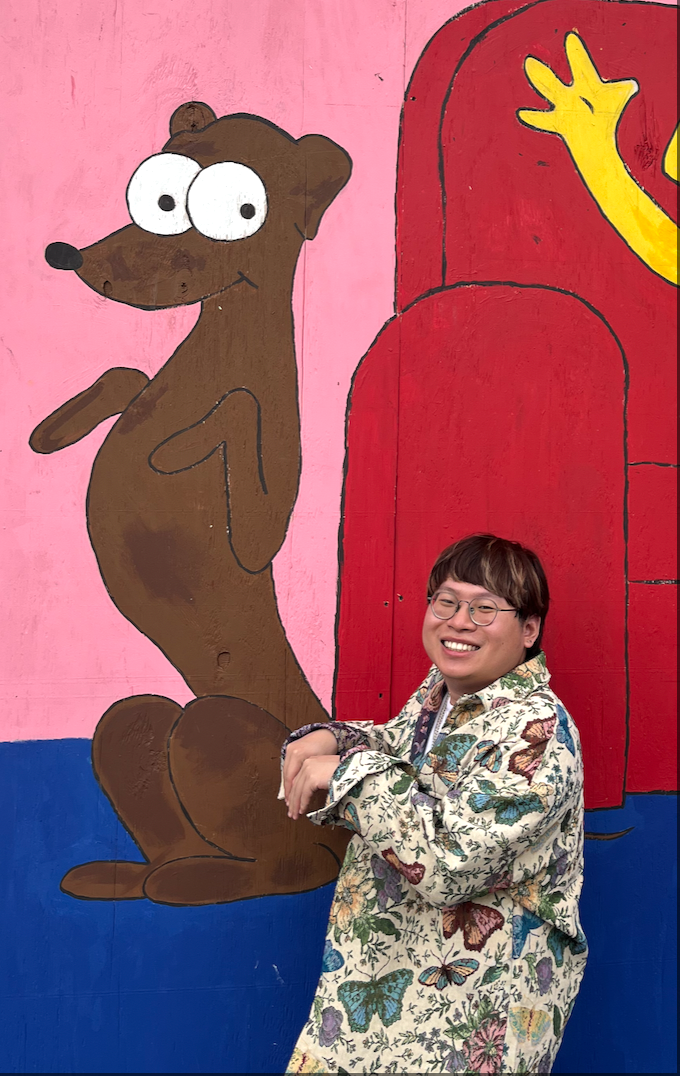
Qing XIAO
PhD Student, Human-Computer Interaction Institute (HCII), School of Computer Science, Carnegie Mellon University
Contact Me: qingx at andrew dot cmu dot edu
How to pronounce my name: Qīng, pronounced like “Ching” (rhymes with “sing”), Xiāo, pronounced like “Shyao” (rhymes with “meow” but starts with a ‘sh’ sound).
Hi! I’m Qing Xiao, a second-year PhD student at the Human-Computer Interaction Institute (HCII) within the School of Computer Science (SCS) at Carnegie Mellon University (CMU). I am very fortunate to be advised by Dr. Hong Shen and be part of CARE (Collective AI Research and Evaluation) Lab at CMU. I previously earned my MSc from the Oxford Internet Institute (OII) at the University of Oxford. I also hold a BA in Communication with a minor in Human-Centered Design from the Communication University of China (CUC).
My research focuses on Human–Computer Interaction (HCI), Economic Sociology, and Management Studies. I aim to understand, design, and develop AI systems for future work and organizations, with particular interests in human–AI relationships. First, I study how emerging AI technologies reshape organizational development, professional authority, and team collaboration. Second, I develop AI systems that are better suited to workplaces and collaborative environments, and I explore how workflows and organizational forms can be redesigned in light of new AI capabilities.
Selected Publications
For a full list of publications see here. Also in Google Scholar.
Qing Xiao, Xinlan Emily Hu, Mark E. Whiting, Arvind Karunakaran, Hong Shen, and Hancheng Cao. 2025. AI hasn’t fixed teamwork, but it shifted collaborative culture: A longitudinal study in a project-based software development organization (2023–2025). arXiv. [Link]
Qing Xiao, Qing (Diane) Hu, Jingjia Xiao, Hancheng Cao and Hong Shen. 2025. Can GenAI move from individual use to collaborative work? Experiences, challenges, and opportunities of integrating GenAI into collaborative newsroom routines. arXiv. [Link]
Qing Xiao, Rongyi Chen, Jingjia Xiao, Tianyang Fu, Alice Qian Zhang, Xianzhe Fan, Bingbing Zhang, Zhicong Lu, and Hong Shen. 2025. Institutionalizing folk theories of algorithms: How Multi-Channel Networks (MCNs) govern algorithmic labor in Chinese live-streaming industry. arXiv. [Link]
Qing Xiao, Yuhang Zheng, Xianzhe Fan, Bingbing Zhang and Zhcong Lu. 2025. Let’s influence algorithms together: How millions of fans build collective understanding of algorithms and organize coordinated algorithmic actions. 2025 ACM CHI Conference on Human Factors in Computing Systems (CHI’25). [ACM Library] [Preprint] [Peking Quack News]
Qing Xiao, Xianzhe Fan, Felix M. Simon, Bingbing Zhang and Motahhare Eslami. 2025. “It might be technically impressive, but it’s practically useless to us”: Motivations, practices, challenges, and opportunities for cross-functional collaboration around AI within the news industry. 2025 ACM CHI Conference on Human Factors in Computing Systems (CHI’25). [ACM Library] [Preprint] [Blog Article]
Selected Non-archival Conference Presentations
Rongyi Chen, Qing Xiao, Shike Lin, Jingjia Xiao, Menghan Yin, Hua (Sara) Zhong, Bingbing Zhang. 2025. When memes become mean: Discrimination recognition and group norms in adolescent bullying. 2025 Association for Education in Journalism and Mass Communication (AEJMC) Annual Conference. Mass Communication & Society Division. 2nd Place Top Faculty Paper Award. 🏆
Qing Xiao and Yuhang Zheng. 2024. Decoding algorithms, engaging fans: The empirical dance of understanding and manipulating algorithms in fan communities. 2024 Association for Education in Journalism and Mass Communication (AEJMC) Annual Conference. Communication Technology Division. 3rd Place Top Student Paper Award. 🏆
Menghan Yin and Qing Xiao. 2024. Active and passive social media use and self-stigmatization among Chinese patients with gynecological disorders: The mediating role of social support. 2024 Association for Education in Journalism and Mass Communication (AEJMC) Annual Conference. Communicating Science Health Environment Risk Division. 2nd Place Top Student Paper Award. 🏆
Teaching
Spring 2024, Academic Tutor, Fandom Studies (Tutorial), Magdalen College, University of Oxford
Autumn 2021, Teaching Assistant, Political Communication, Communication University of China
Spring 2021, Teaching Assistant, International Journalism, Communication University of China
Autumn 2020, Teaching Assistant, Quantitative Research Method, Communication University of China
Research Mentorship
2025, Qing (Diane) Hu – Master, Interaction Design, Carnegie Mellon University
2025, Ziyan (Ethan) Xin – Undergraduate, Computational Neuroscience, Carnegie Mellon University. Co-developed an LLM-based journalism assistant system for Public Source, a nonprofit news organization serving the Pittsburgh region.
2024, Xianzhe Fan – Undergraduate, Tsinghua University, Summer Intern at CMU. Co-authored papers published at CHI 2025 * 4 (Full Paper) and VRST 2024 (Poster). First placement: PhD Student, Computer Science, The University of Hong Kong
2024, Zihe Ran – Undergraduate, Communication, Communication University of China. Co-authored papers published at ASSETS 2025 (Full Paper), CHI 2025 (Full Paper) and VRST 2024 (Poster); First placement: MSc Student, Oxford Internet Institute, University of Oxford.
2024, Xiyu Li – Undergraduate, Communication, Communication University of China. Co-authored paper published at ASSETS 2025 (Full Paper) and CHI 2025 (Full Paper); First placement: MSc Student, Institute of Communication Studies, Communication University of China
Services
Ad Hoc, Manuscript Reviewer, ACM CHI (12), ACM CSCW (2), ACM UIST (1), ACM/IEEE HRI (3), Journalism Studies (1), Journal of Contemporary China (1), Scientific Reports (1), ICLS (1), Transformative Works and Cultures (1), In-Mind Magazine (in-mind.org) (1), NeurIPS Workshop (3), AIED Workshop (3), ICA Conference (20+), NCA Conference (10+), AEJMC Conference (10+), AEJMC Southeast Colloquium (2). *Special Recognitions for Outstanding Reviews: CHI 2026; UIST 2025; CSCW 2024
2025, Student Volunteer, CMU HCII PhD Open House
2023-2024, Student Representative, Oxford Internet Institute, University of Oxford
Fun Fact
My first name, “卿,” is one of the oldest Chinese characters. In its original pictographic form, which dates back to the Shang Dynasty (ca. 1600–1046 BCE, about 3,600 to 3,100 years ago), the character depicts two people sitting across from each other on the ground, sharing a meal from a vessel filled with food or drink. The image embodies the act of gathering together to eat and drink. Over time, “卿” came to signify the closest forms of human bonds, between best friends, between husband and wife, or between a monarch and the trusted minister who shared his fate through life and death.
I prefer to be called “Qing” (“卿”) because it carries both warmth and trust. On one level, it can be read as an invitation: let’s eat and drink together. On another, it conveys intimacy and loyalty: you are my best friend, the one I can trust most.
 Qing Xiao